Architecture
This page explains how the terraform-aws-http-redirect module works internally.
Architecture Diagram
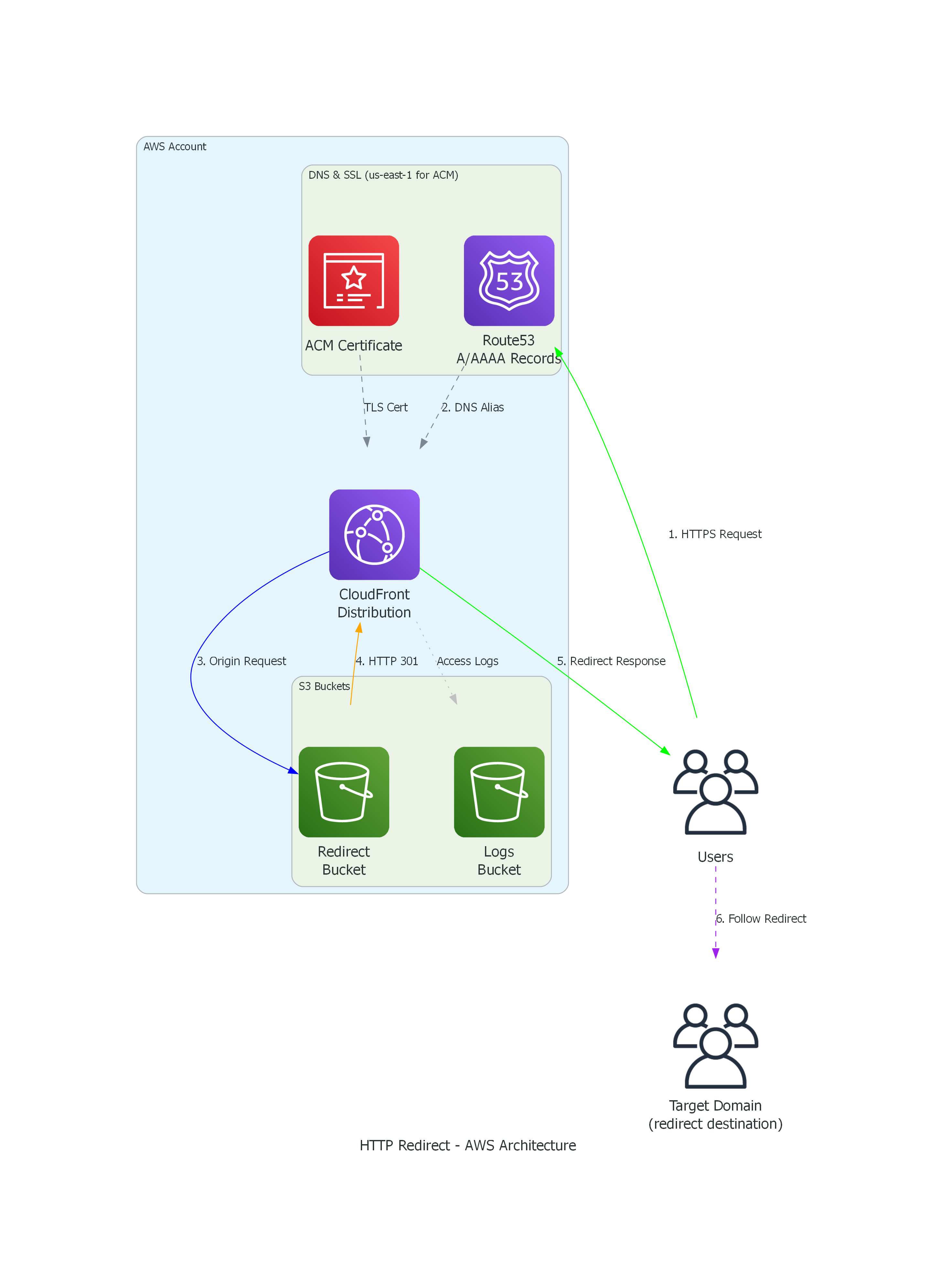
Component Overview
Route 53
Route 53 provides DNS resolution for redirect domains:
- A Records: IPv4 aliases pointing to CloudFront
- AAAA Records: IPv6 aliases pointing to CloudFront
- CAA Records: Certificate Authority Authorization for ACM
The module creates DNS records for each hostname in redirect_hostnames, computed against the hosted zone.
ACM Certificate
ACM (AWS Certificate Manager) provides the TLS certificate for HTTPS:
- Region: Must be in
us-east-1(CloudFront requirement) - Validation: DNS validation using Route 53 records
- Coverage: Single certificate covers all redirect hostnames
The module automatically:
- Creates the certificate request
- Creates DNS validation records in Route 53
- Waits for certificate validation
CloudFront Distribution
CloudFront serves as the entry point for all requests:
- TLS Termination: Handles HTTPS using the ACM certificate
- HTTP to HTTPS: Forces all HTTP requests to HTTPS
- Caching: Caches redirect responses (301s are cacheable)
- Security Headers: Adds HSTS, X-Frame-Options, etc.
- WAF Integration: Optional AWS WAF attachment
Configuration highlights:
viewer_protocol_policy = "redirect-to-https"  # Force HTTPS
price_class           = var.cloudfront_price_class
web_acl_id            = var.web_acl_id  # Optional WAF
CloudFront Function (Optional)
When allow_non_get_methods = true or response_headers is non-empty, a CloudFront Function handles all redirect logic at the edge:
- Viewer-Request Stage: Intercepts requests before they reach the S3 origin
- Method-Preserving Redirects: Uses 308/307 for POST/PUT/DELETE/PATCH (preserves HTTP method)
- Custom Response Headers: Adds user-defined headers to redirect responses
- Query String Preservation: Reconstructs query strings from CloudFront's structured format
The function is written in cloudfront-js-2.0 runtime and deployed from a template (templates/redirect-all-methods.js.tftpl).
Status code selection:
permanent_redirect | GET/HEAD | POST/PUT/DELETE/PATCH |
|---|---|---|
true (default) | 301 | 308 |
false | 302 | 307 |
When is the function deployed?
The function is created when either condition is true:
allow_non_get_methods = true(need to handle non-GET methods)response_headersis non-empty (S3 cannot add custom headers)
When neither condition is met, the module uses the default S3 website hosting path.
S3 Bucket (Redirect Origin)
S3 provides the actual redirect logic via website hosting:
- Website Hosting: Enabled for redirect functionality
- Routing Rules: Define redirect behavior
- Encryption: Server-side encryption (AES256)
- Access: Blocked from public access (CloudFront only)
Redirect configuration:
<RoutingRules>
  <RoutingRule>
    <Redirect>
      <Protocol>https</Protocol>
      <HostName>target.com</HostName>
      <ReplaceKeyPrefixWith>path/</ReplaceKeyPrefixWith>
      <HttpRedirectCode>301</HttpRedirectCode>
    </Redirect>
  </RoutingRule>
</RoutingRules>
S3 Logs Bucket (Optional)
Stores CloudFront access logs for compliance:
- Enabled: By default for ISO 27001/SOC 2 compliance
- Retention: Logs retained per your organization's policy
- Format: CloudFront standard log format
Request Flow
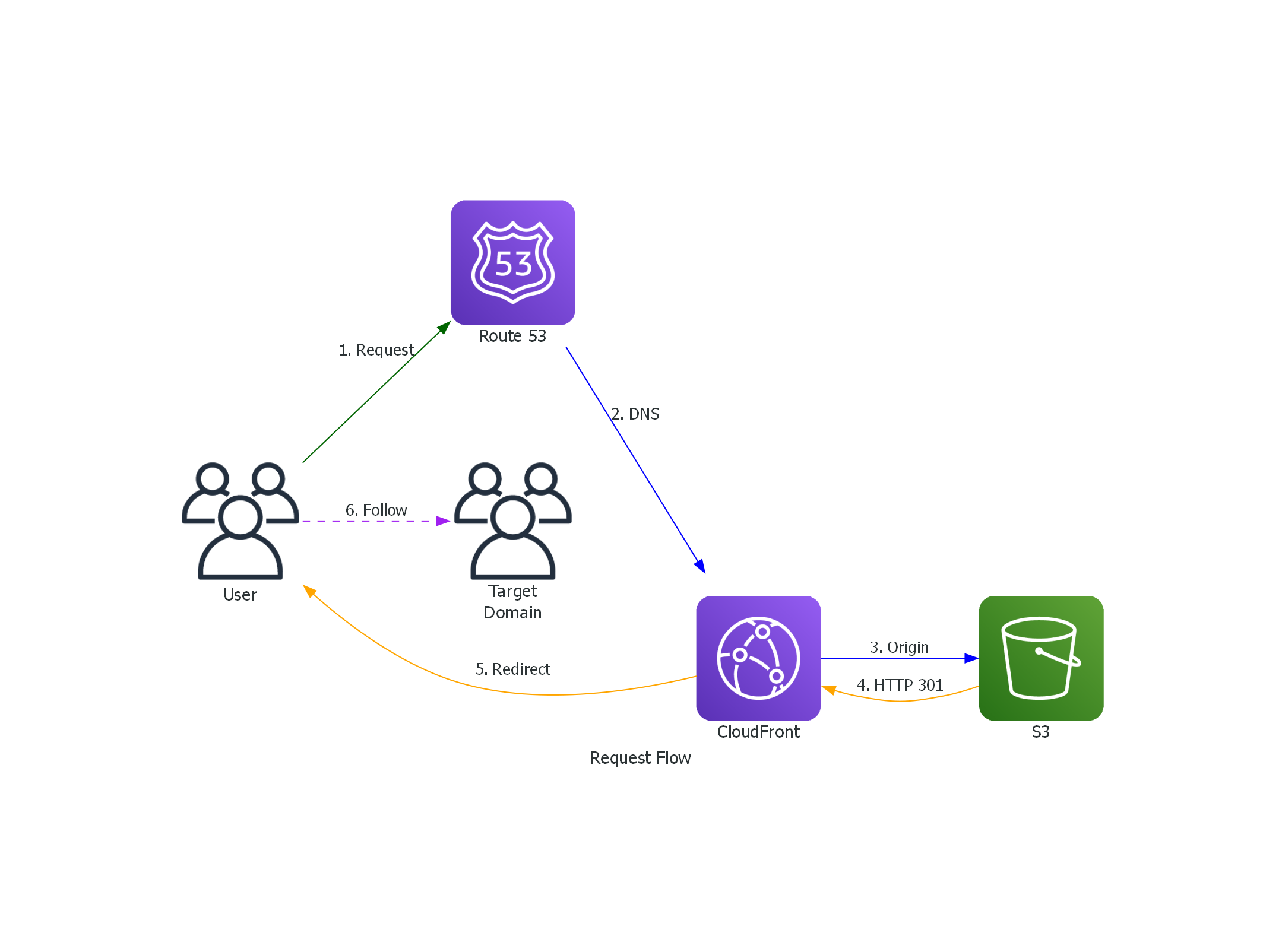
Detailed Request Flow
-
User Request: User visits
https://example.com/page?query=1 -
DNS Resolution: Route 53 returns CloudFront distribution's domain
-
TLS Handshake: CloudFront terminates TLS using ACM certificate
-
Origin Request: CloudFront forwards request to S3 website endpoint
-
S3 Response: S3 returns HTTP 301 with:
-
CloudFront Response: CloudFront returns 301 to user (caches response)
-
Follow Redirect: User's browser follows redirect to target domain
Request Flow with CloudFront Function
When allow_non_get_methods or response_headers is enabled, the flow changes at step 4:
-
User Request: User sends
POST https://example.com/api/data?key=value -
DNS Resolution: Route 53 returns CloudFront distribution's domain
-
TLS Handshake: CloudFront terminates TLS using ACM certificate
-
CloudFront Function: The viewer-request function intercepts the request and returns the redirect response directly (the S3 origin is never reached):
-
Follow Redirect: Client follows redirect to target domain, preserving the POST method and request body
Security Features
TLS/SSL
- ACM certificate with automatic renewal
- TLS 1.2+ enforced by CloudFront
- HTTPS-only viewer protocol policy
Security Headers
CloudFront adds these headers to all responses:
| Header | Value | Purpose |
|---|---|---|
| Strict-Transport-Security | max-age=31536000 | Force HTTPS |
| X-Frame-Options | DENY | Prevent clickjacking |
| X-Content-Type-Options | nosniff | Prevent MIME sniffing |
| X-XSS-Protection | 1; mode=block | XSS filter |
| Referrer-Policy | strict-origin-when-cross-origin | Control referrer |
S3 Security
- Public access blocked at bucket level
- SSL-only access enforced via bucket policy
- Server-side encryption (AES256)
Cost Breakdown
| Resource | Cost Driver | Typical Monthly Cost |
|---|---|---|
| CloudFront | Requests + data transfer | $1-10 |
| S3 Redirect Bucket | Minimal storage | < $0.01 |
| S3 Logs Bucket | Log storage | $0.05-0.50 |
| Route 53 Records | Query volume | $0.40/million |
| ACM Certificate | Free | $0 |
Total estimated cost: $1-15/month for low-traffic redirects
Resource Dependencies
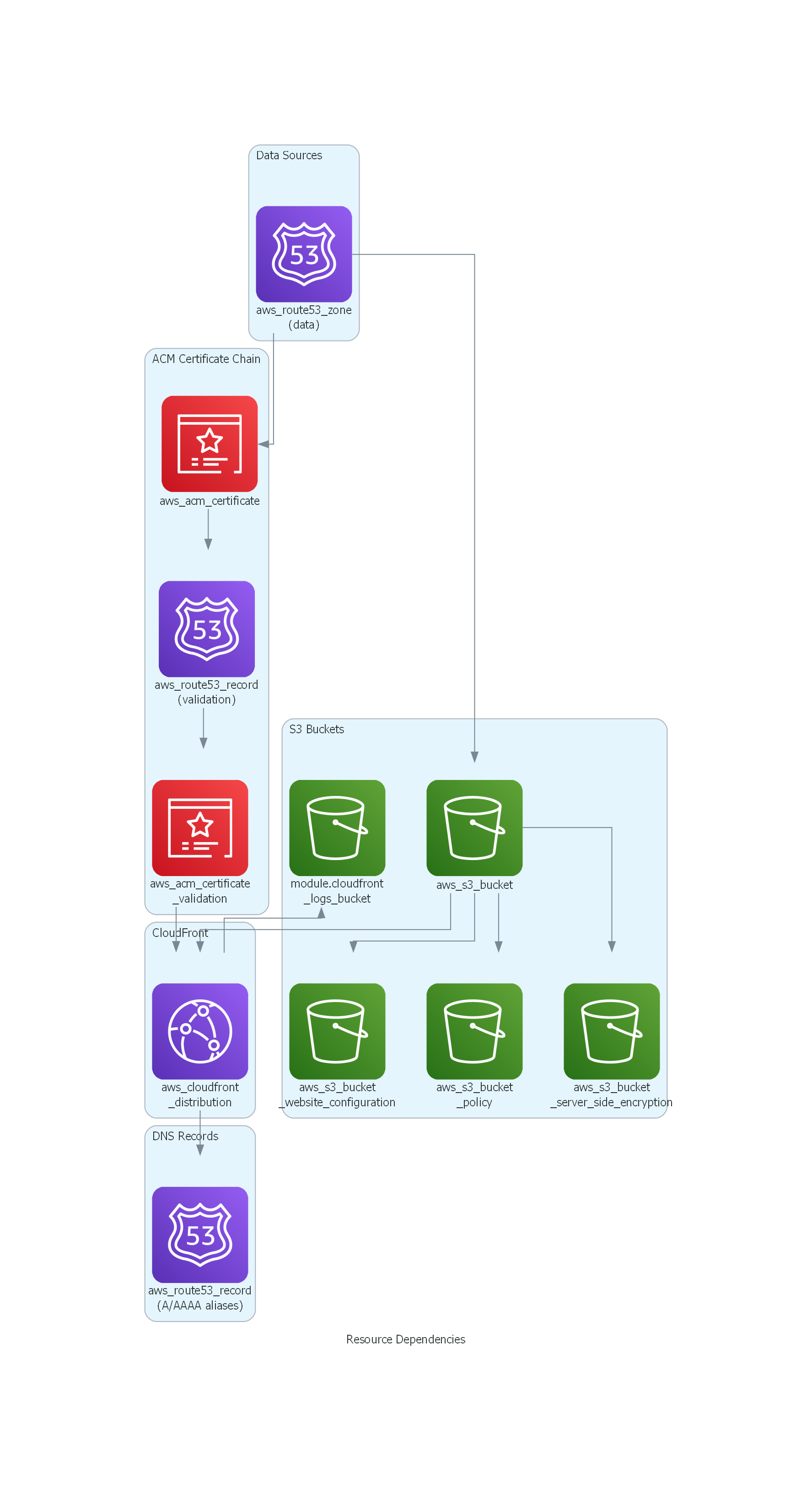
Regenerating the Diagrams
The diagrams are generated using the Python diagrams library:
cd docs/assets
pip install diagrams
python architecture.py
python request_flow.py
python dependencies.py
This creates architecture.png, request_flow.png, and dependencies.png in the current directory.