Architecture
Overview
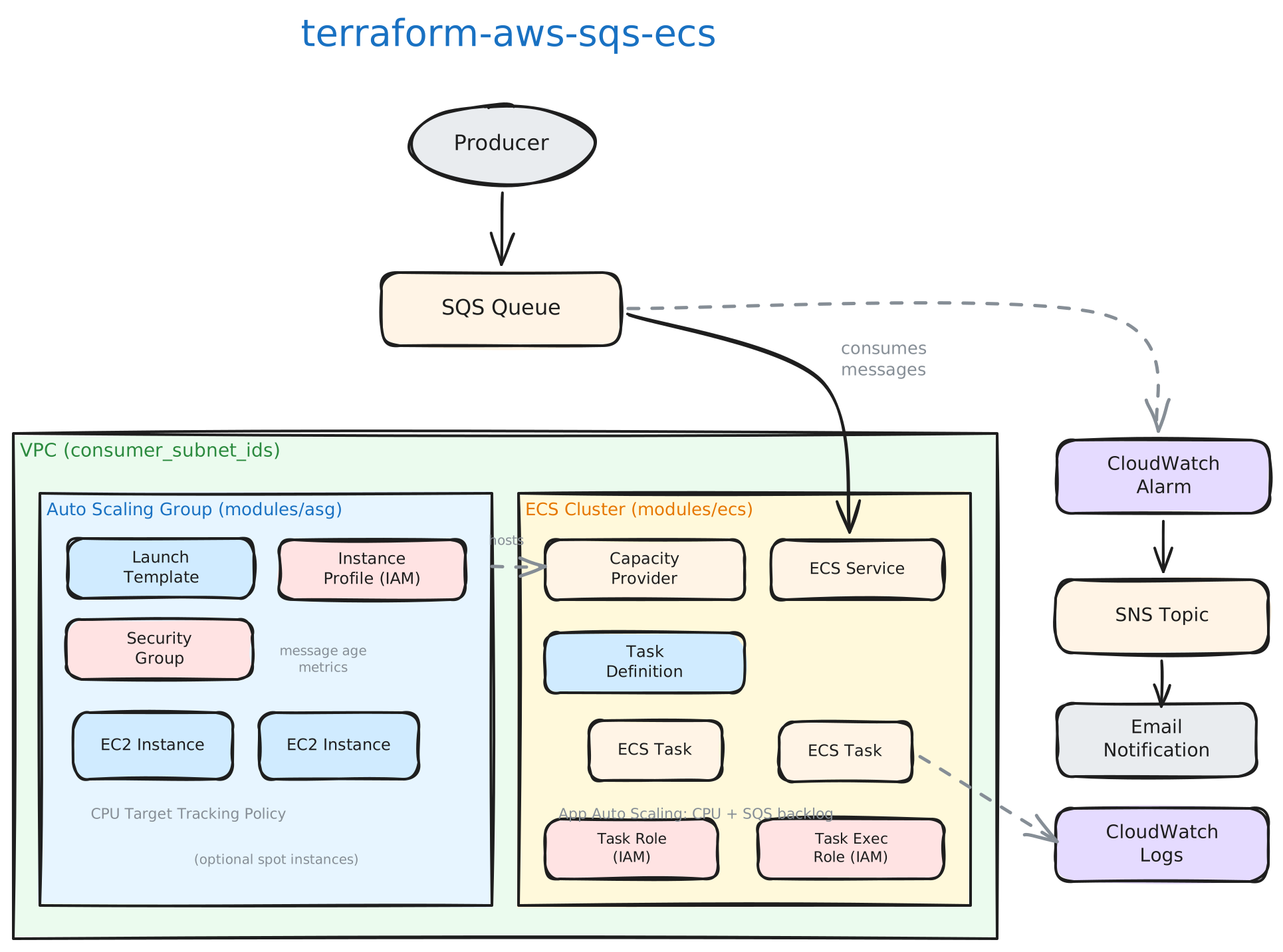
This module creates an SQS queue and an ECS service backed by EC2 instances to process queue messages.
Components
SQS Queue
The module creates an SQS queue with server-side encryption enabled. The queue supports both standard and FIFO modes.
Dead-letter Queue
With enable_dead_letter_queue = true, the module creates a second queue, <queue>-dlq (<queue>-dlq.fifo for a FIFO queue, since SQS requires a FIFO queue's dead-letter queue to be FIFO too), encrypted as the queue is:
- The queue's redrive policy (
aws_sqs_queue_redrive_policy) moves a message there when consumers have received itdead_letter_queue_max_receive_counttimes (5 by default) without deleting it. SQS moves it on the receive after that. - The dead-letter queue's redrive allow policy admits only the module's queue.
- It keeps messages 14 days, SQS's maximum. A standard queue's message keeps its original enqueue time when it moves, so it has at least 10 days there after the queue's 4.
- The CloudWatch alarm
<dead-letter queue>-depth-alarmemailsalert_notification_email, through the message-age alarm's SNS topic, when the dead-letter queue holds any message (ApproximateNumberOfMessagesVisible > 0over 5 minutes). Without data it keeps its state: SQS stops publishing an idle queue's metrics.
On a FIFO queue, a message that moves to the dead-letter queue leaves its message group, and the group's later messages are processed without it. Leave the option off if they must never be.
By default there is no dead-letter queue: a message that consumers keep failing on returns to the queue after each visibility timeout until it expires.
ECS Service
The ECS service runs consumer containers as tasks on EC2 instances. Each task pulls messages from the SQS queue and processes them. The task definition includes:
- Consumer container with configurable CPU/memory quotas
- CloudWatch agent sidecar for metrics collection
- Optional EFS and local volume mounts
- Secret injection from AWS Secrets Manager
EC2 Auto Scaling Group
The ASG provides EC2 instances that host ECS tasks. Key features:
- ECS-optimized AMI (latest by default)
- Optional spot instance support with configurable on-demand base capacity
- Scales based on CPU utilization
Task Placement
The module calculates tasks_per_instance based on the EC2 instance type's CPU/memory and the task's resource quotas. This determines how many tasks can run on each instance, accounting for:
- Host OS memory reservation (1 GB)
- CloudWatch agent container resources (128 CPU units, 256 MB memory)
- Consumer task CPU and memory quotas
Auto-Scaling
Two scaling policies work together:
CPU-Based Scaling (ECS)
Targets average CPU utilization across all tasks (default: 60%). When CPU exceeds the target, ECS adds more tasks.
SQS Backlog Scaling (ECS)
Monitors the ratio of visible messages to running tasks. When the backlog per task exceeds the target (default: 100 messages), ECS scales up.
ASG Scaling
The ASG scales to provide enough EC2 capacity for the desired number of ECS tasks, calculated as:
IAM Roles
- Task Role - Attached to the running container. Add policies for SQS access, S3, DynamoDB, etc.
- Task Execution Role - Used by ECS agent to pull images and write logs.
- Instance Profile - Attached to EC2 instances for ECS cluster registration.